What were the main conclusions from the SWP Conference?
Strategic workforce planning (SWP) is no longer about spreadsheets and headcount forecasts. It’s about driving real business change.
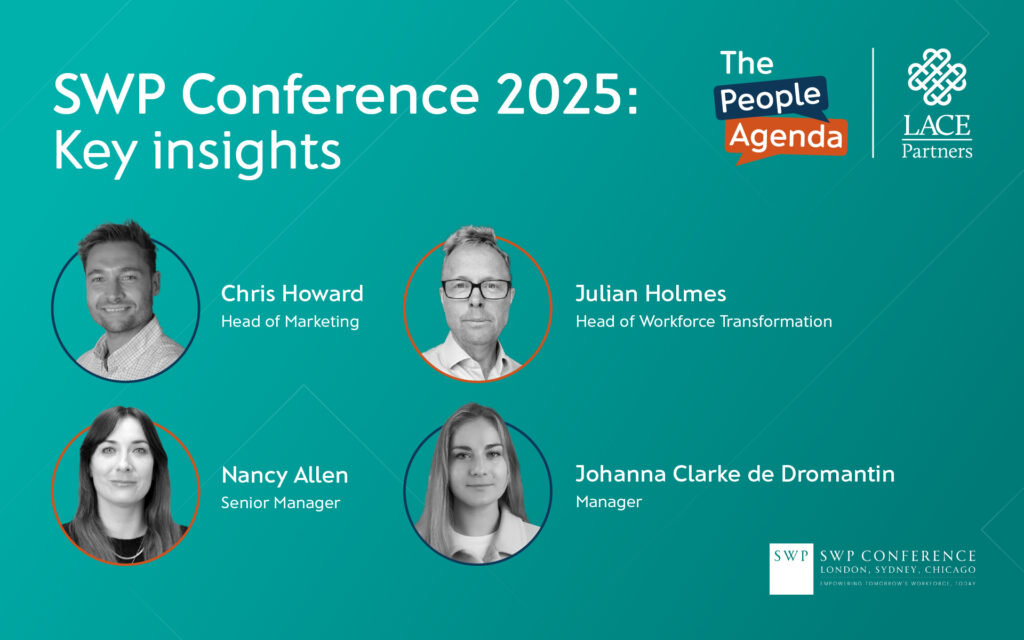
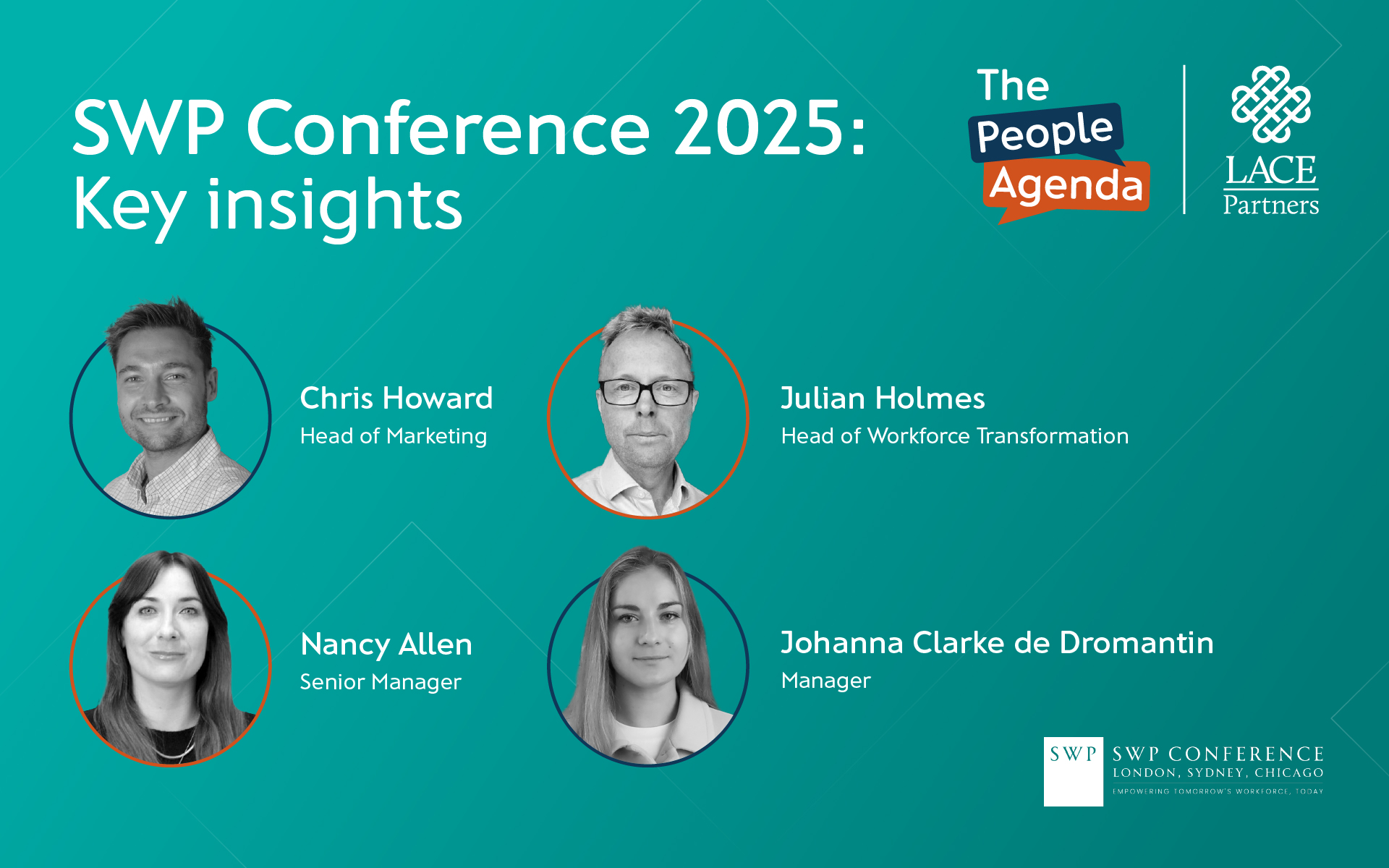
In this episode of the People Agenda podcast, host Chris Howard is joined by some of our people analytics team; Nancy Allen, Jo Clarke de Dromantin and Julian Holmes as they reflect on the SWP Conference London. During the conference it was acknowledged how SWP had shifted from cost control to business transformation. Today, SWP exists to tackle real business challenges including productivity, growth, skills shortages, and AI adoption, rather than simply managing numbers or budgets.
Why are organisations moving to task-based workforce models?
AI automates tasks rather than whole jobs, which means organisations need a clearer understanding of work at a task level. The conference highlighted that traditional job architectures aren’t fit for the AI era. Instead, organisations should move towards mapping tasks that make up each role to better understand where AI can add value and how work will evolve. Our guests noted this concept was described as “a huge opportunity” because few companies have the data maturity to implement it yet.
What business problems is SWP expected to solve now?
SWP is being used to address immediate strategic challenges, not future hypotheticals. Common problems SWP is being used to solve include:
- Skill shortages in digital, AI, and technical roles.
- Work location strategy, including regulatory and geopolitical shifts.
- AI workforce impacts, including redeployment modelling.
- Productivity and operating model transformation.
Modelling workforce value, not just workforce cost, was highlighted as an emerging practice.
How is the role of HR changing as a result?
HR is stepping into the role of strategic business modeller rather than administrative implementer. Conference discussions reinforced that HR must move beyond process delivery to actively shape business decisions, workforce strategies, and transformation outcomes. The evolving role of HR should:
- Be embedded inside business decision-making not attached to it later.
- Act as strategic advisor and shaper, not policy owner.
- Combine SWP with organisation design, people analytics and talent analytics.
Want a deeper dive into HR’s new role in business transformation? Our campaign, Proactive people transformation and whitepaper explore that topic in more detail.
What pressures are forcing urgency into SWP?
Permanent disruption, rapid skills erosion, and CEO demand for faster answers. The conference presented stark data:
- 96% of organisations experienced a major business disruption within the last two years.
- Two-thirds of the global workforce requires substantial upskilling to keep pace with change.
- One-third must reskill simply to perform their current roles.
This reality has created a “perma-crisis” environment, one of continuous change rather than episodic transformation.
What foundational capabilities are now required for effective SWP?
High-value SWP depends on modelling skills and data maturity, not only reporting accuracy. SWP must have the ability to:
- Build scenario models of workforce change.
- Test assumptions quickly.
- Translate people data into financial and operational outcomes.
- Enable cross-business collaboration
Our view? SWP should not aim for “perfect forecasts” but focus on directional clarity and decision support.
What risks were highlighted around inclusion and ethics?
Poorly governed SWP could widen inequality within workplaces. If task-based redesign and upskilling programmes are not managed equitably it could result in the creation of “elite upskilling groups” while:
- Mid-career and older workers are left behind.
- Lower-visibility functions receive fewer development opportunities.
- Unequal access to flexible working as task roles shift.
What were the strongest closing messages from the conference?
Start simple and include the full workforce. Two important reminders stood out:
- Progress matters more than perfection, and it’s better to begin SWP with imperfect models than delay action.
- Real business value comes through continuous iteration, not waiting for a final “perfect” design.
SWP also needs to account for all forms of work. That means looking beyond full-time employees to include contractors and contingent labour, as well as bots, automation systems, and AI agents. Workforce planning is evolving into workforce plus automation planning, reflecting how work is truly delivered today.