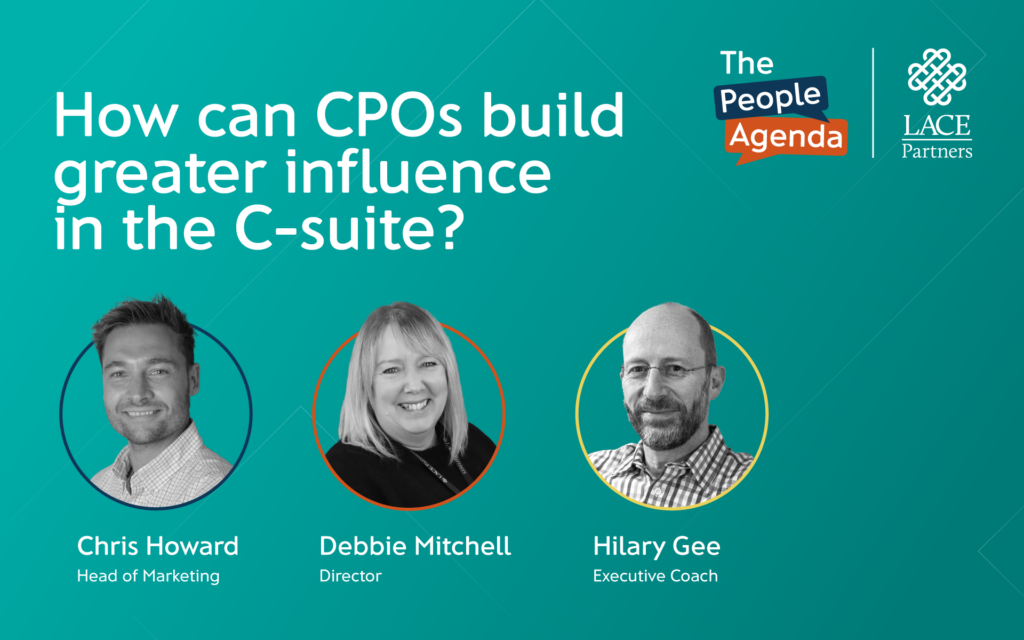
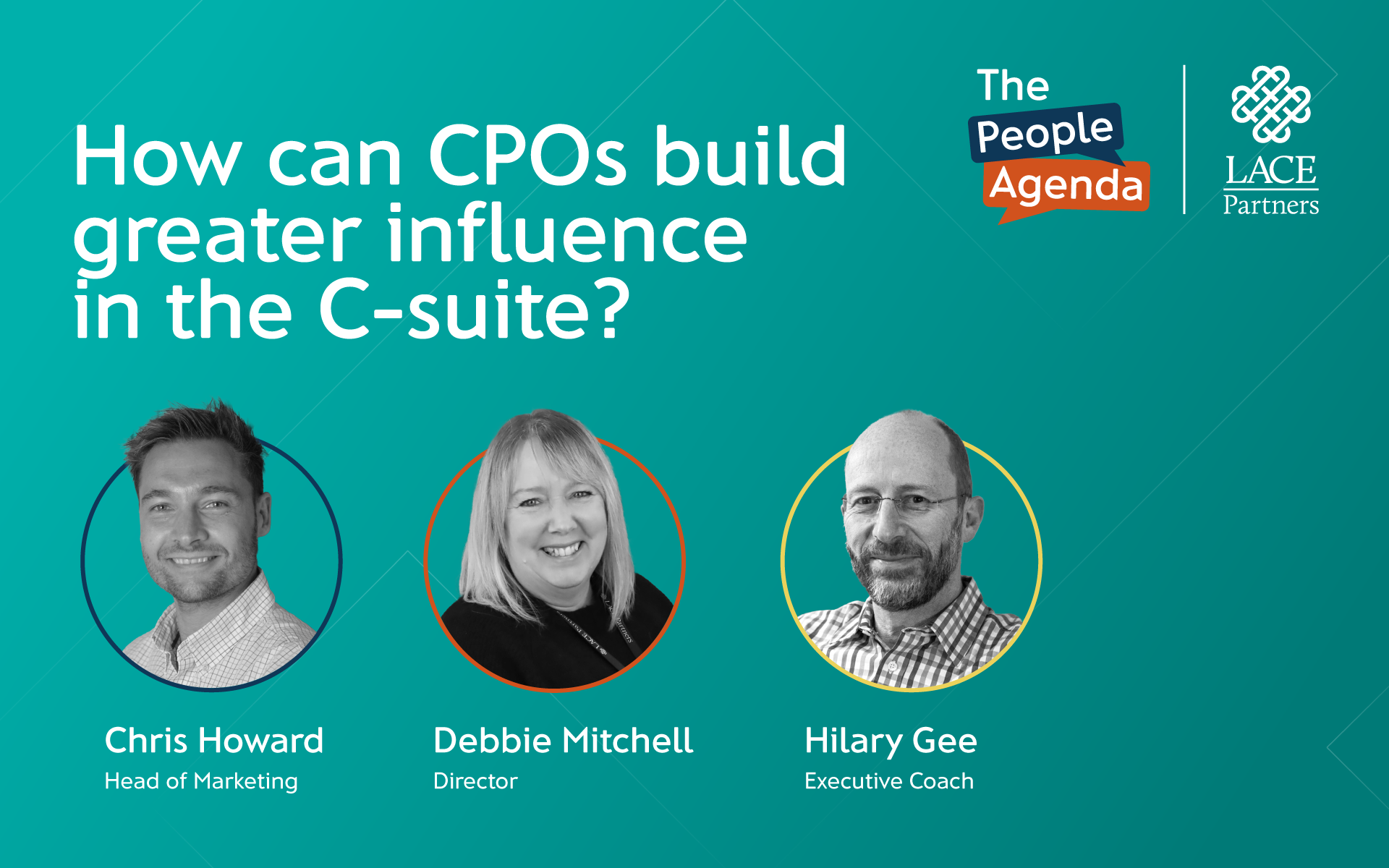
Great leadership does not start with a title. It starts with influence. In this episode of The People Agenda podcast, we explore one critical question: how can today’s Chief People Officer (CPO) move from having a seat at the table to genuinely shaping business transformation? Drawing on insights from our research “From implementer to influencer” host Chris Howard and fellow LACEr Debbie Mitchell speak to executive coach Hilary Gee, on how CPOs can build influence among the C-suite. As a part of our research LACE surveyed 450 C-level executives (CPOs, CEOs, CFOs, COOs and CTOs) in large organisations in the UK, GCC and North America.
Why isn’t having a seat at the table enough?
Having a seat at the C-suite table is no longer the primary challenge, influence is. Our research shows that while 64% of leaders say HR is actively involved in shaping decisions, a quarter (25%) say HR is considered but not central to the decision-making process.
In many organisations, CEOs and CPOs interact infrequently, limiting alignment on strategic priorities, while CFOs and COOs undervalue HR’s contribution to business-wide outcomes. HR is often viewed as functionally strong but commercially light and transformation leadership is still, in some cases, perceived as operational rather than people led.
How can CPOs speak the language of the C-suite?
Despite HR’s growing presence at the top table, influence can still stall. 41% of leaders say HR is seen as reactive or lacking measurable impact, limiting its ability to shape strategic outcomes at the highest level. CPOs need to connect people strategy directly to commercial outcomes. Influence grows when HR leaders speak the language of finance, operations, and growth not just culture and engagement. They can strengthen their impact by:
- Framing culture initiatives in terms of productivity, margin, and risk mitigation.
- Presenting workforce investments with quantified ROI ranges and cost-benefit clarity.
- Tailoring communication style to the audience
- Shifting from “employee experience” language to business value creation.
When CPOs are able to align their message with business metrics, their credibility rises significantly.
What makes C-suite collaboration difficult?
Collaboration at the C-suite level often breaks down because leaders are structurally incentivised to focus on their own performance rather than shared outcomes. When finance, operations, and HR each have KPIs that pull in different directions, silos are created before the conversation even starts.
Leadership updates tend to be delivered function by function, with success measured individually instead of against business-wide goals. Over time, this can drive defensive behaviour, as executives protect their metrics rather than lean into collective accountability.
If incentives reward competition, collaboration will struggle. To shift this dynamic, our guest discuss:
- How organisations can introduce shared business metrics alongside functional goals.
- Tie a portion of executive reward to collective performance.
- Structure leadership meetings around strategic priorities instead of departmental update.
- Assign joint ownership of key transformation initiatives.
When collaboration is built into the system, it becomes far more likely to show up in behaviour.
What role does the CEO play in C-suite culture?
Hilary notes that “When you have someone commanding the C‑suite, you create fear. And when people are defensive, they’re less collaborative and creative.” How can other CEO behaviours affect the organisation’s culture?
- CEOs who command tend to generate defensive, siloed behaviours.
- On the flipside, CEOs who lead collaboratively create openness and shared accountability.
- Cultural tone at the top replicates across every organisational layer.
- Business leadership requires shifting from functional excellence to cross-boundary impact.
The C-suite becomes a team only when the CEO actively leads it as one.
How can CPOs influence upwards?
CPOs are uniquely positioned to shape leadership culture, but influence upward requires structure. This is where HR moves from implementer to influencer by:
- Introducing 360-degree feedback for the CEO and C-suite to expose blind spots.
- Using external executive coaching to strengthen business leadership capability.
- Presenting evidence-based case studies that highlight cultural risk.
- Proposing shared metrics or balanced scorecards to reduce siloed incentives.
Building influence is about having structured, evidence-backed conversations.
Why does leadership development at the top matter?
More than a third of large organisations have a business transformation underway at any given time, raising the stakes for CPOs to operate as credible business leaders, not just functional experts. However, few are formally developed as business leaders. Hilary puts this succinctly by stating “Many leaders learn functional expertise, but they don’t actually learn how to lead the enterprise.”
This gap directly impacts transformation success. CPOs can build their influence by showing other C-suite members that they are business leaders not just a people leader. Strong leadership at the top is the single biggest predictor of transformation success.
The shift from implementer to influencer is not theoretical. It is behavioural, structural, and relational. If you are a CPO, CEO, or executive navigating transformation in 2026, this conversation offers practical insight you can apply immediately.
Tune in to this episode of The People Agenda podcast to hear the full discussion and start redefining HR’s role in business transformation. Want to know more takeaways from our research then download our whitepaper “From implementer to influencer”.