
 As organisations navigate continual disruption, many HR functions are questioning whether their existing Shared Services models are still delivering the value, efficiency, and experience originally promised. For some, HR Shared Services (HRSS) has been in place for years, yet challenges persist: limited return on investment, inconsistent adoption across the business, constraints on budget and headcount, difficulty attracting skilled talent into the centre, and operating models that no longer scale effectively in a more dynamic environment.
Across the organisations we work with, it’s clear that no two HRSS journeys look the same. For those operating large‑scale, mature shared service models, the question is less about whether to transform and more about how to scale what’s already built. They must consider how to evolve from incremental automation to more transformational models. This includes maximising AI responsibly, enabling more self‑resolution, reducing transactional activity, and shifting the skillsets toward data literacy, knowledge management, data modelling, and AI‑enabled service design. The challenge becomes moving beyond efficiency to generate meaningful strategic value.
At the other end of the maturity curve, some organisations are only just getting started — still stabilising foundational processes, establishing consistent service delivery, or dealing with fragmented data. For those organisations, the opportunity for transformation is even greater. Rather than following the traditional sequential path, they have the chance to leapfrog legacy models entirely. This might mean bypassing traditional tiered structures and investing directly in top‑tier self‑resolution, AI‑enabled workflow, and smaller, specialised, location‑agnostic teams hired for skill rather than proximity. They must ask fundamental questions: Do we need a traditional HRSS at all? Or should we design a model from the outset that is digital‑first, insight‑led, and unconstrained by geography?
Wherever an organisation sits on this continuum, the priorities converge: define the value HRSS needs to deliver, determine the capabilities required to unlock that value, and build a practical, evidence‑based roadmap anchored in today’s reality and tomorrow’s potential. The dilemma is clear: you can only afford to make this transformation once, so the next design choice must be future‑ready and strategically aligned.
The big question: What will the future HRSS look like?
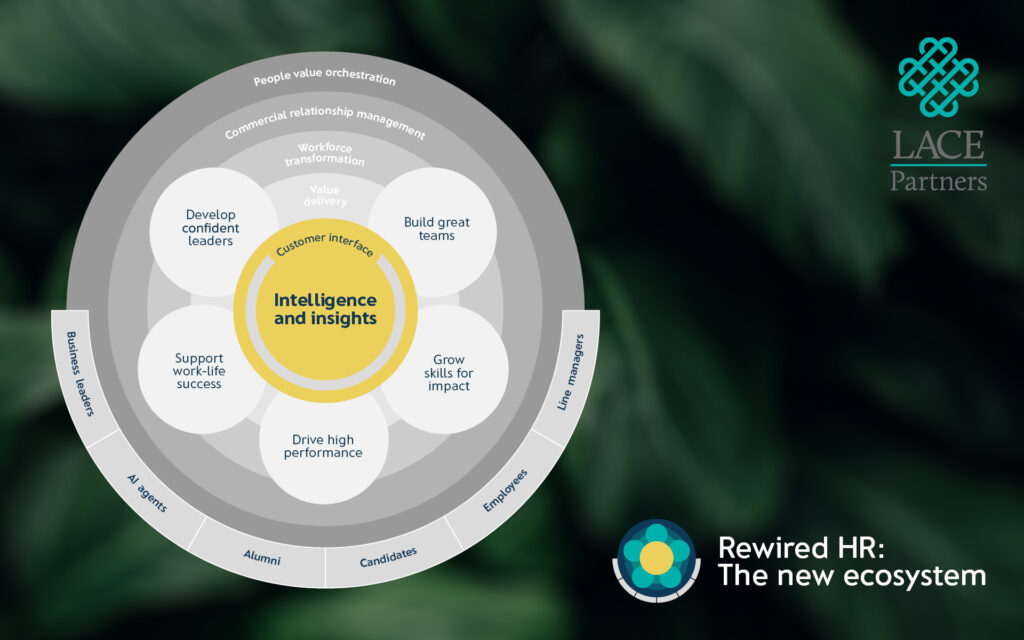
The future HR operating model will be fundamentally different from the past. AI will remove large volumes of tier‑one transactional work. Insight engines will provide predictive capability. Employees will move seamlessly across channels. HR Shared Services will shift from processing to orchestration, intelligence, and experience.
To design for that future, HR leaders must ask:
- What is the boldest and most future‑focused version of HR we want to build?
- How should HR Shared Services fit within that ambition?
- Which human and digital capabilities must we prioritise today to be ready for what’s next?
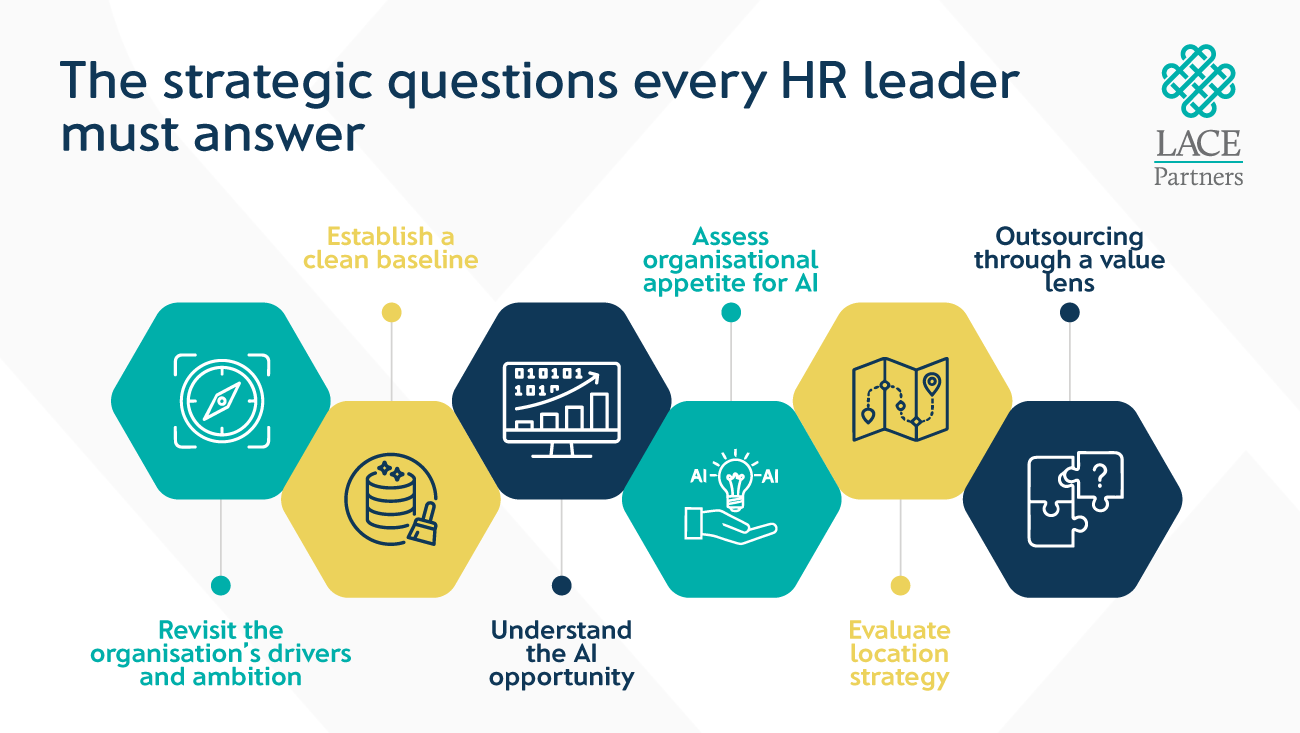
The strategic questions every HR leader must answer
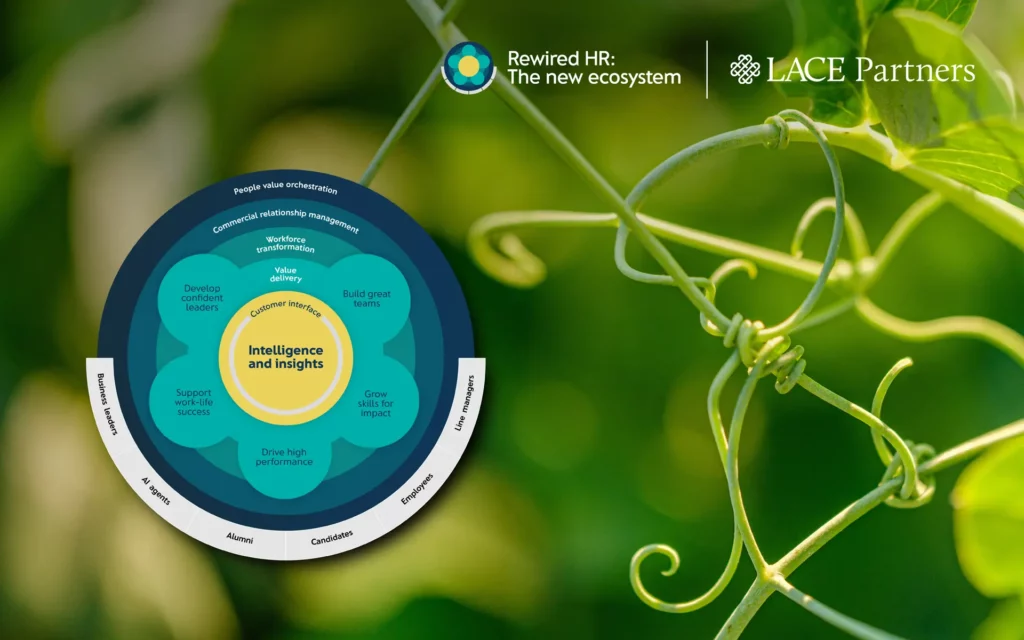
 Click the image to view full screen
1. Revisit the organisation’s drivers and ambition
What is the ultimate aim — cost reduction, improved service, enhanced agility, or becoming a future‑fit, intelligence‑led function?
This ambition drives the value case: the specific outcomes the model must deliver, whether cost efficiency, service quality, speed, insight generation, or agility.
2. Establish a clean baseline
Before making any transformation decisions, leaders must understand the accuracy and reliability of HR data.
AI‑enabled models cannot thrive on fragmented or poor‑quality data.
3. Understand the AI opportunity
With rapid advancements in automation, AI may eliminate the need for traditional offshoring altogether — if the data foundation is strong. HR must assess:
- Where processes can be automated
- What this could release in cost, headcount, or space
- How AI can materially improve employee experience and service quality
4. Assess organisational appetite for AI
Adoption depends on:
- Risk tolerance
- Comfort with experimentation
- Executive sponsorship
- Organisational readiness
This determines the path: incremental augmentation or transformational automation.
5. Evaluate location strategy
Once the AI opportunity is clear, the remaining work must be examined. Leaders should evaluate:
- True cost of relocation
- Employment and transition implications
- Whether relocation solves root‑cause issues
As AI reduces transactional volumes and removes language barriers, traditional hub models lose their scale advantage — making location‑agnostic talent models more viable.
6. Explore outsourcing through a value lens
Outsourcing may create leverage — but only at the right scale and maturity.
As AI increases insight‑generation capability and reduces transactional activity, the debate becomes: “What is left to outsource?”
Capabilities retained in‑house will increasingly be:
- Data management
- Data modelling
- AI prompt engineering
- Knowledge management
How to get started: Building an insights and intelligence engine
The starting point is a clear, evidence‑based value case. Senior HR leaders must understand not just where opportunities lie, but which interventions create the greatest impact with the least friction.
A structured diagnostic helps assess the automation and AI opportunity across the HR scope — both in existing processes and untapped HCM capabilities. This identifies high‑value, high‑feasibility use cases that will materially enhance service delivery.
Once complete, your baseline data becomes the engine for a compelling value case — a quantified, defensible narrative of where AI‑enabled enhancements drive improvements in cost, capacity, service quality, and employee experience.
What this delivers for the organisation
A strategically enhanced HR Shared Services model — powered by automation and AI — evolves the function from process‑centric to intelligent and insight‑driven. It becomes your Insights and Intelligence engine, enabling:
- A more efficient, sustainable, service‑focused function
- A 24/7, language‑agnostic support model
- Greater standardisation and improved user adoption
- Continuous improvement fuelled by real‑time data and insights
In short: by establishing a robust value case and embracing AI‑enabled opportunities, HR leaders can accelerate transformation and strengthen HR’s strategic influence across the organisation.
Ready to rethink your HR Shared Services model? Let’s explore how an intelligence‑led, AI‑enabled approach can unlock value for your organisation. Get in touch to start your transformation.