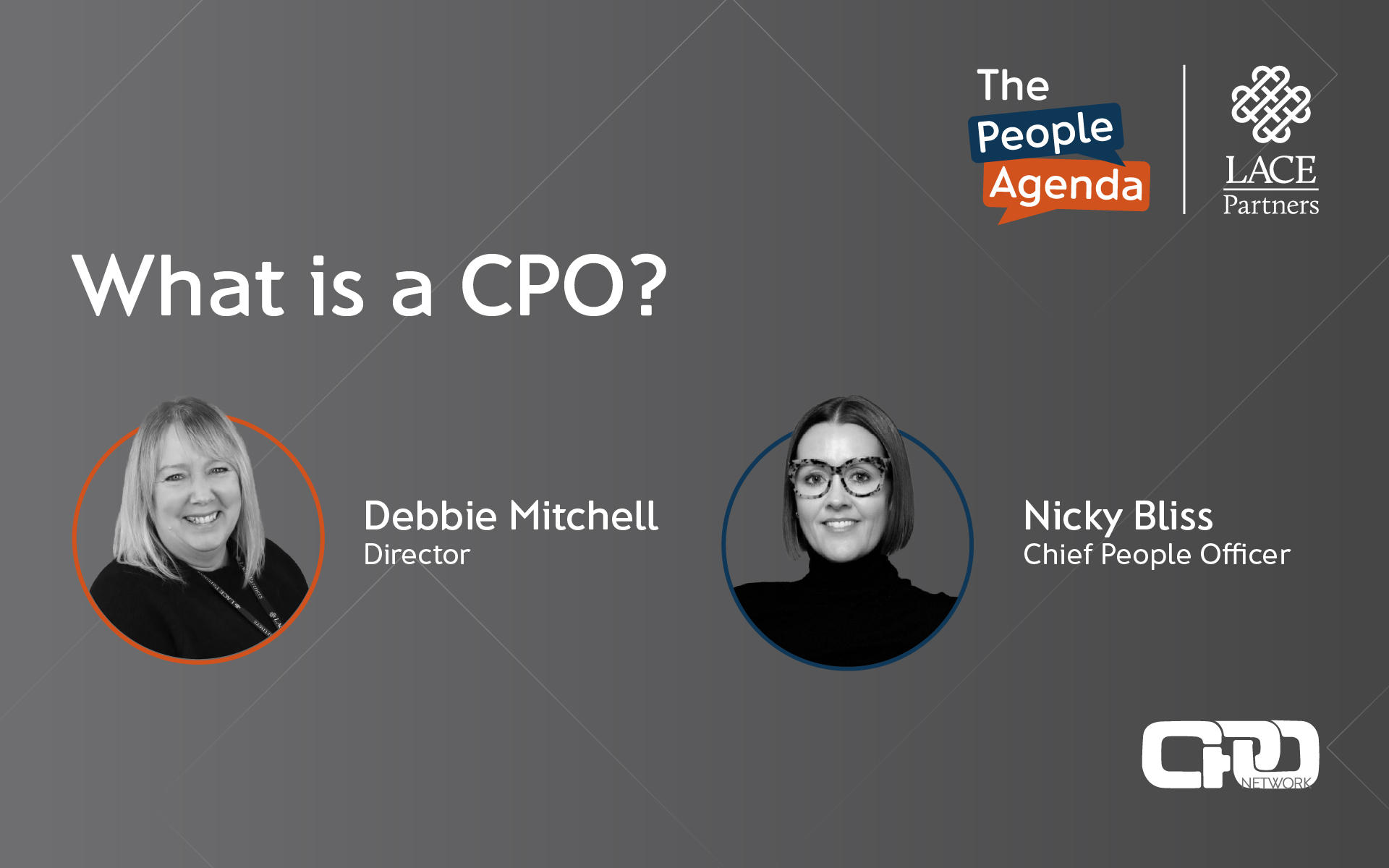
Welcome to the first episode of our new mini-series, What is a CPO? Hosted by Debbie Mitchell, Director at LACE Partners and lead of our CPO Network, this series explores the evolving role of the Chief People Officer (CPO). Through conversations with experienced CPOs, we’ll dive into how the function is changing, the challenges leaders face, and how collaboration is shaping the future of HR.
In this mini-series, we’ll be speaking with leaders who have held or currently hold the role across different industries and sectors. In this episode, Debbie is joined by Nicky Bliss, People Director at Sainsbury’s and a member of our CPO Network. Together, they dive into the central question: What is a CPO?
A CPO is first and foremost a leader of the business, not just of the HR function. They sit at the executive table, helping to drive strategy, profitability, and company culture. The CPO ensures that people initiatives directly support commercial goals whether that means approving payroll, leading transformation projects, or presenting workforce strategies to the board.
How can CPOs build effective teams?
Nicky states that great CPOs don’t wear every hat themselves but instead build a team of specialists. For example:
- HR operations leaders oversee audits and payroll.
- Business partners focus on transformation and change.
- Talent and culture heads manage engagement and leadership development.
The CPO’s role is to coordinate, not micromanage, ensuring each “hat” is worn consistently by experts.
How is the CPO’s influence shaped by company structure?
A CPO’s influence is deeply shaped by the ownership model of the organisation. What do we mean by that? Debbie and Nicky explain:
- Regulated industries: HR is central, focusing on compliance, governance, and employee advocacy.
- Founder-led companies: The CPO acts as a culture guardian, balancing vision with structure.
- Private equity environments: People priorities can be overlooked giving CPOs the chance to prove how great people leadership drives equity value.
Do CPOs still have to fight for a ‘seat at the table’?
In short, no. Modern CPOs already belong at the table. If an organisation doesn’t recognise people as central to success, that’s a sign of poor leadership. Nicky notes that without people, there would be no business. That said, a CPO’s legitimacy comes from delivering commercial results through people, not demanding recognition.
How can CPOs demonstrate commercial value?
To prove the commercial value of its people, a CPO must:
- Understand how the business makes money and how people strategy affects that.
- Speak the language of value i.e. profits, margins, efficiency.
- Use people data to underpin wider decision making
- Link people initiatives to commercial outcomes.
What makes a leadership team truly collaborative?
Silos disappear when organisations invest in leadership communities before crises arise. Nicky and Debbie discuss what makes successful teams and how they:
- Build mutual trust and understanding.
- Spend time learning each other’s strengths and triggers.
- Solve challenges collectively, not by function.
Although this is easier said than done, they discuss how external facilitators can help sustain this collaboration long-term.
What’s next for the Chief People Officer role?
Looking into their crystal ball our experts recommend that the future CPO must:
- Lead specialist teams that cover compliance, transformation, and experience design.
- Balance cost control with value creation.
- Stay current on AI, legal shifts, and industry trends.
- Excel at networking and cross-functional leadership.
What skills define the CPO of the future?
At LACE we love to talk about the ten traits of a successful People function, and this filters down to skills a CPO needs to focus on depending on the business context. Our guest agree that the following are universal:
- Being able to link people strategy to financial performance.
- Adapting to evolving technologies and work models.
- Uniting diverse executive teams through influence.
Does job title matter?
Yes, titles signal influence. While the scope matters more than semantics, few leaders are truly “agnostic”. The title should match responsibility, scale, and pay. A CPO role should reflect strategic authority, not administrative support.
Are you a CPO looking to meet likeminded individuals? Our CPO network meet semi-regularly to share insights, discuss challenges and people solutions around the fast-evolving role of a CPO.