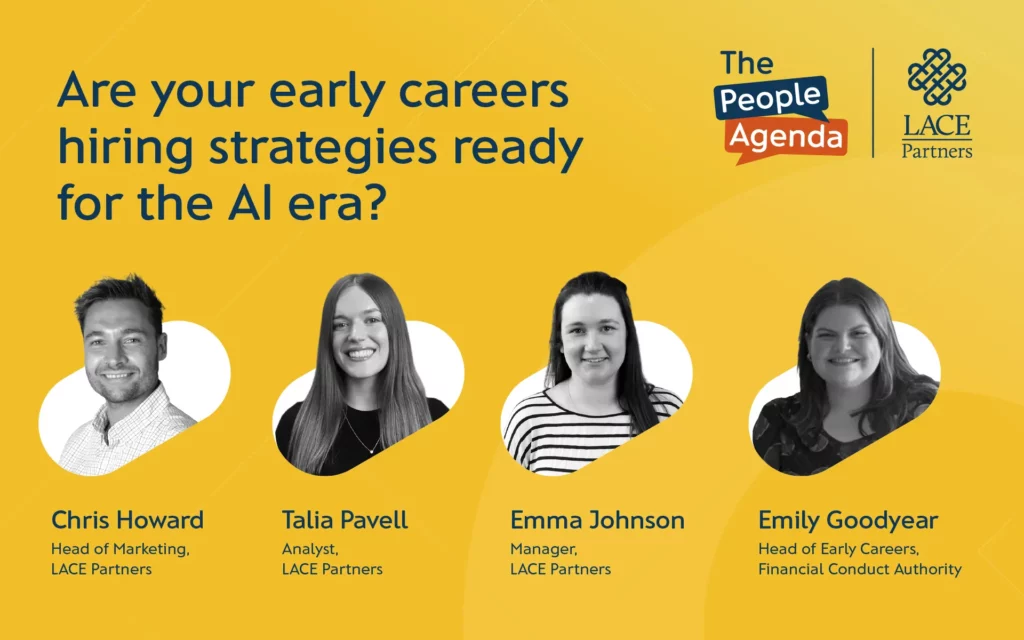
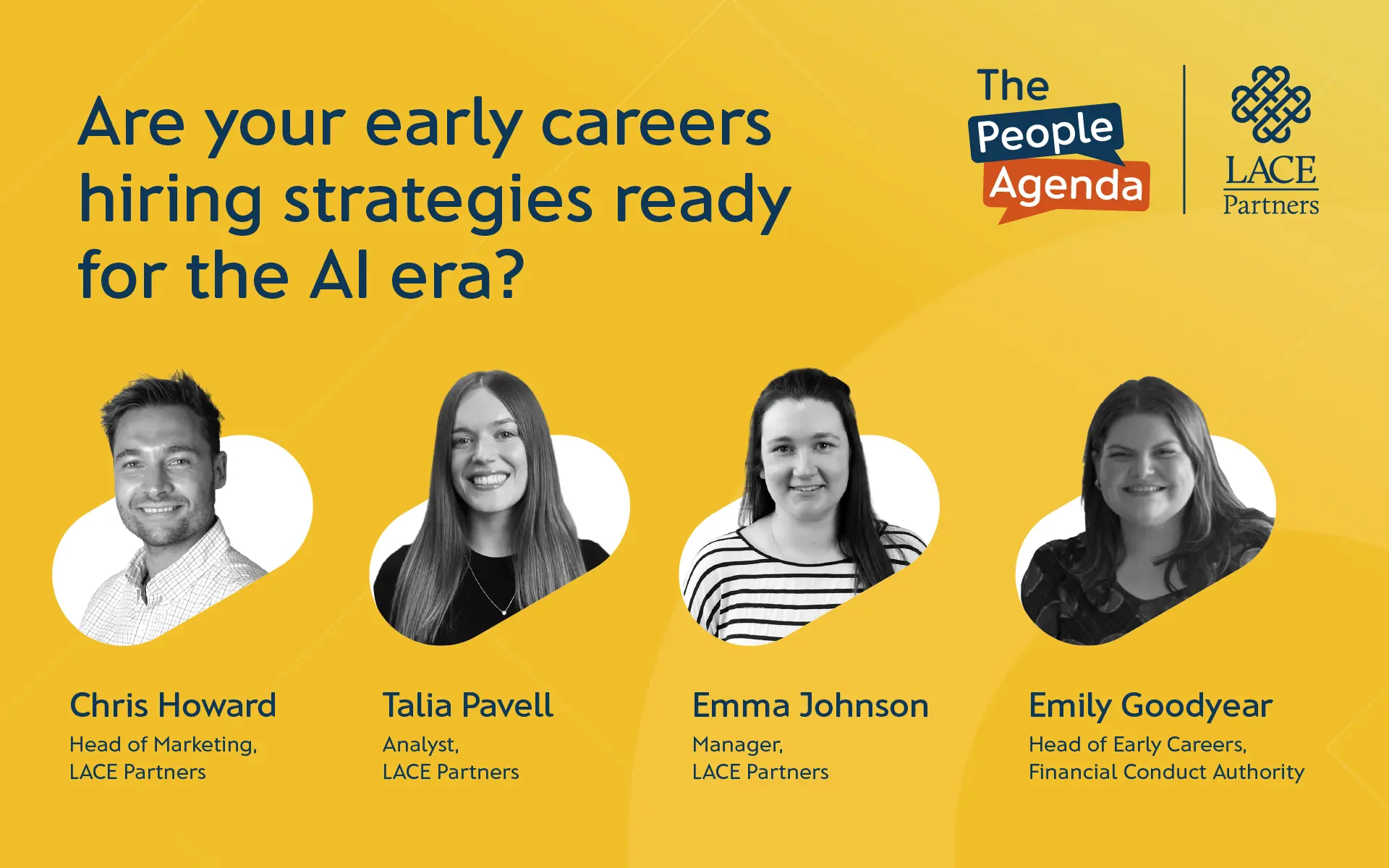
The future of early careers is being rewritten in real time. As AI reshapes entry-level work and application volumes surge, employers are rethinking what makes talent stand out and candidates need a new playbook to keep up. In this episode of The People Agenda podcast, host Chris Howard is joined by LACErs’ Emma Johnson and Talia Pavell, alongside Emily Goodyear, Head of Early Careers at the Financial Conduct Authority (FCA), to explore how AI is changing early careers from every angle.
What skills matter most for early careers in 2026?
While technical capability still matters, the skills rising fastest in demand are distinctly human. As Emily Goodyear explains, “one of the four behaviours that we focus on at the FCA is judgement – how you critically evaluate the information in front of you and think through how you’re making your decisions.” In an AI-enabled workplace, these decision-making capabilities become even more critical.
The most in-demand early careers skills include:
- Critical thinking and judgement
- Adaptability and agility
- A growth mindset
- Communication and relationship-building
- Curiosity and openness
How is AI changing entry-level roles?
AI is reducing traditional administrative and process-heavy work, pushing junior employees towards higher-value responsibilities at an earlier stage.
In practice, this means:
- An estimated 60–70% of traditional entry-level tasks can now be automated
- Early-career roles are shifting from execution-focused to judgement-focused
- Junior employees are expected to contribute to decision-making sooner
- Roles are increasingly being redesigned around human–AI collaboration
- Removing entry-level roles altogether risks long-term damage to talent pipelines
How are employers assessing candidates differently?
With application volumes soaring, organisations are moving away from relying solely on CV screening and placing greater emphasis on potential. Emily highlights this shift clearly: “what we are looking for is potential – the strengths that mean you’re well suited to grow, not that you come in as the finished article.”
As a result, strengths-based assessments, assessment centres and scenario-based exercises are playing a growing role in evaluating how candidates think, solve problems and make decisions in practice. While AI and automation support employers in managing scale, human oversight remains critical to fairness and the overall candidate experience.
Why is competition for early careers roles increasing?
Application volumes are rising sharply, making it harder than ever for candidates to stand out. From an employer perspective, the scale of change is stark.
Economic uncertainty is pushing more candidates towards structured early-career programmes, while AI-assisted applications are increasing both the volume and polish of submissions. For employers, this creates new pressure to filter candidates efficiently without losing quality or fairness.
How can candidates stand out in this market?
In a highly competitive and increasingly automated market, focusing on human strengths is key. Drawing on her own experience of entering the workforce, Talia Pavell explains: “with so much being automated, it’s really about showing your human skills – how you communicate, build relationships and contribute in that way.”
Candidates who emphasise learning potential and adaptability are best positioned to succeed by demonstrating:
- Adaptability with concrete examples
- Strong communication and interpersonal skills throughout the process
- Curiosity and enthusiasm for learning over polished expertise
- Varied experiences as evidence of resilience and a growth mindset
What should organisations do next?
Rather than simply reducing junior hiring, organisations need to rethink early careers strategies for an AI-integrated workforce. As Emma Johnson cautions, “if you remove entry-level roles entirely, you risk damaging your long-term talent and skills pipeline.”
The focus should be on defining future skills first, then redesigning roles and programmes to develop capabilities such as judgement, critical thinking and leadership. Creating safe environments where early-career talent can experiment, learn from mistakes and build confidence is essential – as is continued investment in coaching, development and succession planning.
If you want the full discussion and deeper insight from the panel, listen to the podcast to hear how leading employers are rethinking early careers for the AI era.