The conversation around AI in the workplace is shifting fast and the real tension isn’t about technology, it’s about ownership. Who actually “owns” AI inside an organisation today?
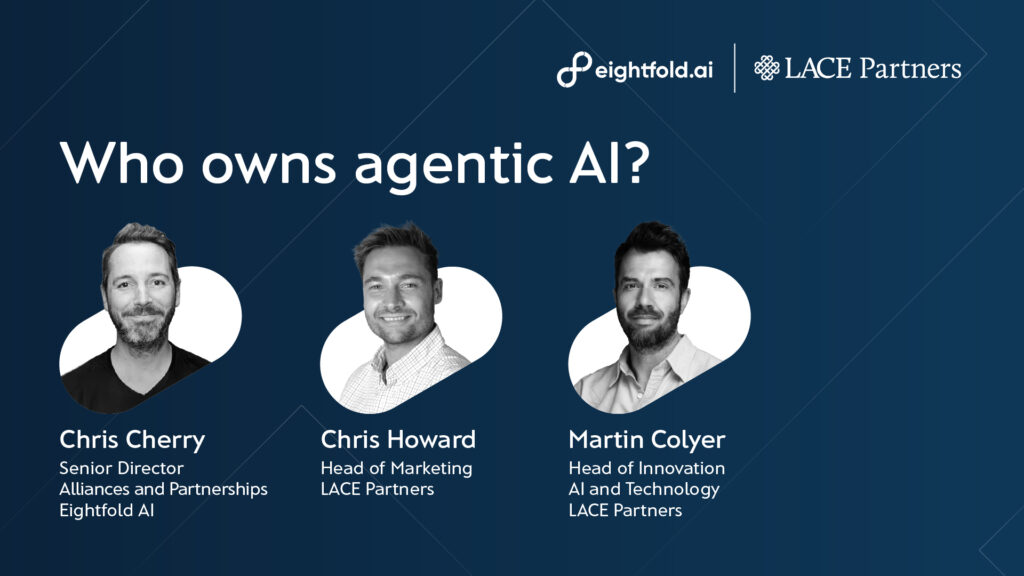
In this episode of The People Agenda podcast Chris Howard and LACE Director of AI Data and Technology, Martin Colyer, speak with Chris Cherry from Eightfold. They cut through the noise and explore how HR, IT, and business leaders are navigating agentic AI, and real-world adoption. We also collaborated with Eightfold on a webinar centred around this topic which you can watch on demand here.
Who should lead the AI strategy in the modern workplace?
HR must take centre stage in owning the AI strategy because agentic AI functions more like a worker than a traditional software tool. While IT has historically managed technology decisions, the move toward AI agents requires a focus on operating model design, workflow placement, and the handoff process between humans and digital agents. At LACE we are calling this “The AI + Human network”. Below are some reasons why AI could sit in each function:
- HR: Focuses on operating model design and the integration of AI agents as members of the workforce.
- IT: Provides the underlying infrastructure, manages cybersecurity, and mitigates data leakage risks.
- Cross-functional leadership: Some organisations have combined HR and IT under a single leader to accelerate deployment.
- Chief AI Officer: This emerging role represents an inflection point where tech and people management roles blur. We explore the role of a Chief AI Officer in more detail in this video.
What is agentic AI and why does it matter?
Agentic AI refers to systems that can act independently to complete tasks and workflows, going beyond basic automation into decision-making and execution. Instead of relying on constant human input, these systems can handle multi-step processes, connect across different platforms to run workflows end-to-end, and learn from data to improve over time. As a result, AI starts to move from being a supporting tool to acting more like a digital worker. This marks a fundamental shift, Chris Cherry explains, “traditionally the workforce has been a user of technology, with agentic AI the technology itself becomes part of the workforce.”
How can organisations bridge the communication gap between CPOs and CIOs?
Leaders need to develop a shared language by becoming more digitally savvy and service-oriented, so their functions don’t end up working in silos. Traditionally, HR and IT have spoken different “languages,” which can create friction, especially when governance is seen as a blocker rather than something that enables progress.
For CPOs, this means building AI fluency as a core skill so they can engage confidently with the C-suite and CIO. At the same time, CIOs need to see their role as supporting people and the wider business, not just managing technology. When both sides align on common goals and shared accountability, governance shifts from being a hurdle to something that actively supports and protects innovation.
How is AI changing HR’s role?
HR is evolving from process owner to strategic enabler of skills and workforce intelligence. AI is pushing HR toward a more data-driven and forward-looking function by:
- Transitioning to a skills-first approach in hiring and development
- Using AI to identify talent gaps and internal mobility opportunities
- Enhancing decision-making with predictive analytics
- Reducing manual administrative workload through automation
What is a skills-first approach?
A skill-first approach prioritises capabilities over job titles or credentials. Chris Cherry explains, “a skills‑first approach reflects how work actually gets done, rather than how roles have traditionally been defined.” This model aligns better with how work is actually performed in modern organisations as it:
- Focuses on measurable skills rather than degrees or past roles
- Enables more flexible hiring and internal mobility
- Improves workforce planning accuracy
- Supports reskilling and upskilling at scale
What challenges do organisations face with AI adoption?
The biggest barriers are alignment, governance, and clarity of purpose. Chris Cherry acknowledges that “most organisations don’t struggle with capability; they struggle with coordination and ownership.” This leads organisations to having:
- A lack of clear ownership and accountability structures
- Concerns around data privacy, ethics, and compliance
- Resistance to change from employees and leadership
- Difficulty translating AI potential into measurable business value
What does successful AI adoption look like?
Successful adoption is use-case driven, collaborative, and outcome-focused. Organisations that win with AI start small and scale intentionally.
- Begin with specific, high-impact use cases
- Align HR, IT, and business stakeholders early
- Establish governance frameworks from the start such as our TRUSTED Framework for AI
- Measure success using clear KPIs
How can the HR function future-proof itself against rapid change?
Getting the basics right is the most important first step for any organisation looking to future-proof its operations. With the pace of change so fast that strategies can become outdated within months, HR leaders need to prioritise continuous learning and building AI fluency. Ultimately, it’s not about competing with AI, but about developing the skills to guide and use it effectively.
AI is an operational reality that demands clarity, coordination, and action. If you want to hear the full discussion, including real examples and practical insights from industry experts, take the next step and listen to this podcast.