
In brief
- AI at Level two supports your thinking, not just your output – helping change teams diagnose issues, spot patterns and pressure-test assumptions earlier.
- Practical applications include stakeholder influence mapping, persona stress-testing, micro-behaviour design and readiness analysis.
- The risks are real: false certainty, data bias and over-automating judgement are all traps – and staying accountable for the final product matters more than ever.
AI is one of the most disruptive forces impacting businesses today and it’s already changing the day-to-day reality of transformation delivery.
In our first blog, we covered ‘The starting point – Level one’ and gave advice on how to get started with using AI for your transformation tasks while also sharing practical advice on how to keep the human touch at the centre of AI-enabled change and unlock your change team’s potential when working with AI.
In this blog, we explore Level two ‘AI supports transformation thinking’ and show you practical examples of how to take your use of AI from performing tasks to supporting your thinking, together with an overview of the real opportunities and risks that operating at this level of AI literacy brings with it.
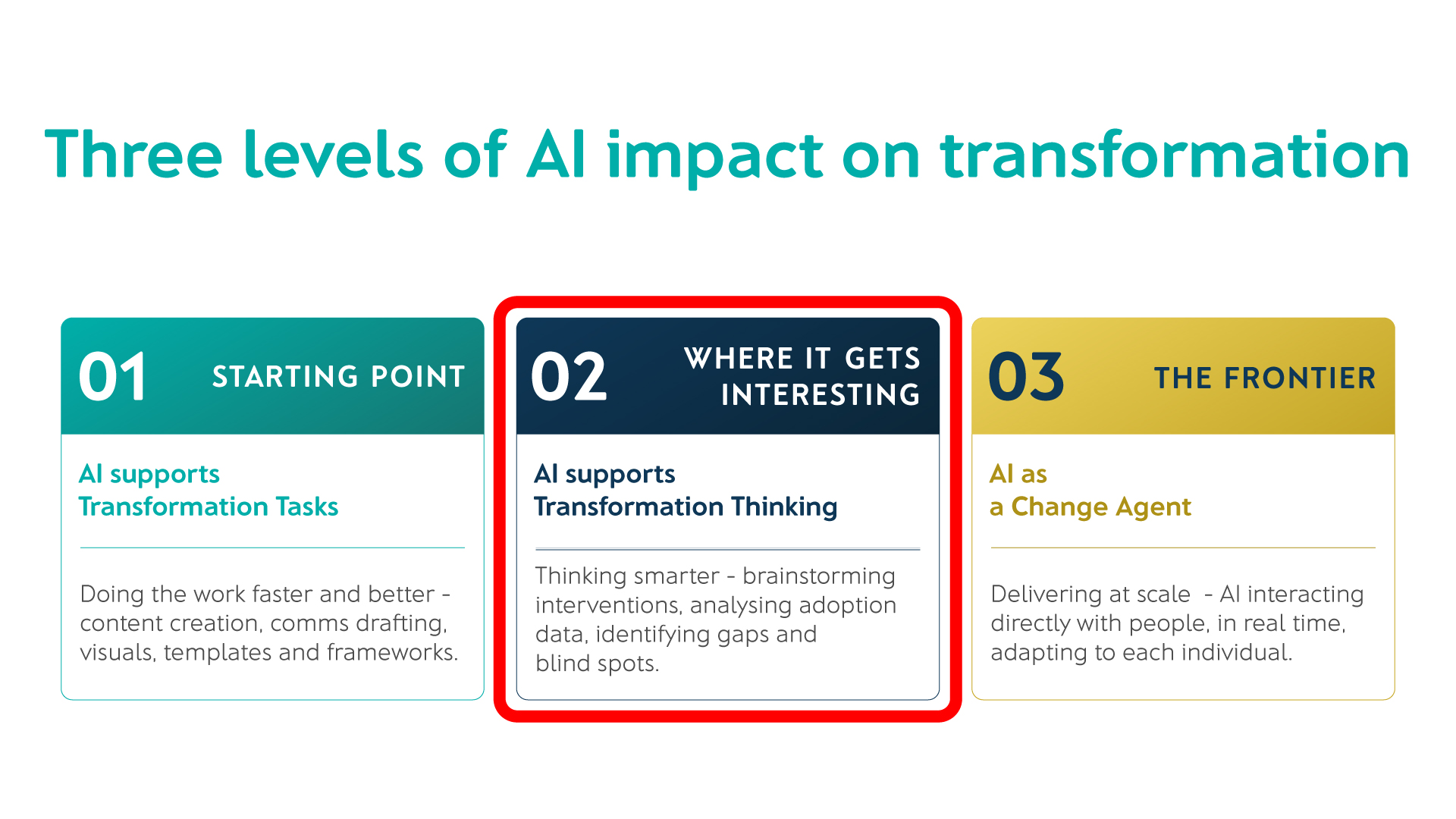
Where it gets interesting – Level two: AI supports transformation thinking
Level two is where AI stops being a production engine and becomes something more useful: a thinking partner and co-creator.
It’s not necessarily that your change team suddenly needs fewer people, or you should become less creative. It’s that you can be more effective, make better decisions, have greater reach and be more innovative with less noise, less guesswork, and fewer blind spots. AI at this level supports and elevates your work. It helps with diagnosing what’s really going on, spotting patterns across messy inputs, pressure-testing assumptions, and generating ideas and drafting solutions you can build on and apply your judgement to.
In practice, Level two strengthens your ability to be creative, strategic and proactive in your transformation delivery.
Where it makes a difference
The point isn’t to use AI for everything you do, but to think carefully about where it makes your thinking sharper, and where it helps move from generic “good change” to evidence-led decisions and creative interventions that solve the challenges of the transformation you are working on. Here are a few examples:
1. Stakeholder mapping: spotting influence dynamics and resistance themes
Stakeholder analysis can be manual and subjective. AI can help structure the thinking by generating likely resistance themes by stakeholder group (based on role, incentives and past change experience), drafting engagement approaches that match influence and interest, and building tailored briefing packs for relationship owners, including likely questions and credible responses.
Practical inspiration to get started*: When using AI, provide access to relevant resources like stakeholder lists and what’s changing (make sure to be careful when using any personal or IP information; only run this kind of prompt in your approved corporate system), and ask it to list the most likely influence dynamics and resistance themes across each group, and suggest ideas for mitigations.
*Our practical inspirations are short versions of real-life uses of AI for change, aimed at change managers. If you want to know more about how we are AI-optimising change tools and deliverables, please use the form below to get in touch.
2. Personas and user journeys: stress-testing ‘moments that matter’
Personas and journeys are only as good as the insight behind them. AI can help you compare persona needs against journey touchpoints to identify mismatch, surface likely ‘moments that matter’ where adoption risk is highest, and suggest targeted support (job aids, nudges, manager prompts, peer support) for each moment.
Practical inspiration to get started: When using AI, provide access to relevant resources like personas and drafted user journeys, and prompt it to list the ‘moments that matter’ where adoption issues are most likely to emerge, and draft suggested interventions to reduce adoption risk.
3. Behaviour and mindset mapping: making behaviours observable
Behavioural work often gets stuck at the level of aspiration (“be more data-driven”, “collaborate better”). Ask AI to turn that into observable micro-behaviours and likely drivers: what triggers the behaviour, what makes it hard, and what would make it easier. Then use the outputs to design interventions that are specific enough to stick (manager routines, small defaults in a process, prompts in tools, peer reinforcement).
Practical inspiration to get started: When using AI, provide access to relevant resources like the behavioural aspiration for the change and prompt it to list observable micro‑behaviours that show the desired behaviour change is happening, the likely drivers and barriers behind each. and practical ways to measure it.
4. Readiness measurement: turning scores into actions
Dashboards show where readiness stands, but not what to do about it. AI can help identify plausible drivers of low readiness (capability gap vs process misalignment vs local leadership signals), recommend additional measurements and when (beyond activity), and draft targeted intervention options based on the data patterns alongside what to stop doing if it isn’t improving readiness.
Practical inspiration to get started: When using AI, provide access to relevant resources like your business readiness scores (by segment and over time), and prompt it to list the most plausible drivers behind the patterns, and suggest relevant next steps based on this insight.
Benefits and risks – keeping your eyes wide open
AI will elevate your methodologies and work to new heights. But it is in collaboration and co-creation with you that the magic happens. Always think about the benefits and risks it carries, and keep your eyes wide open to ensure your work is of the highest quality and not AI slop.
Benefits
- Earlier, sharper intervention: spotting friction enabling you to be proactive when there’s still time to do something about it
- Better prioritisation: seeing where adoption effort is most needed so you can be smarter about prioritisation
- Improved consistency: insights are easier to track and compare across countries, functions or phases, giving you a holistic view
- Stronger governance: pressure-testing risks and mitigations to help you strengthen recommendations and decision-making
- Freeing up time: more time for you to coach, listen and influence leaders and stakeholders
Risks
- False certainty: AI can sound confident, but you need to check logic and ask for evidence
- Bias in, bias out: AI reflects the quality of the data you give it; your responsibility is to ensure high data quality to avoid bias or skewed insights
- Over-automation of judgement: AI makes suggestions; you add context and judgement
- Confidentiality and sensitivity: Feedback often contains personal and organisationally sensitive information, so you need to ensure guardrails and clear governance are in place
- Deceiving looks: AI produces professional-looking outcomes but isn’t bulletproof; you are responsible for the final product
To mitigate these risks, ask AI to play back what it is basing its thinking on, where it found a specific quote, and how it reached a conclusion. Treat it as your thinking partner while also holding it to account for its ideas and solutions.
Getting started
Make sure you read part 1 ‘The starting point – Level one’ and look out for part 3 ‘AI as a Change Agent – Level Three’ where we explore how AI stops being part of the change teams toolbox and starts to become a Change Agent in its own right. AI is changing what transformation delivery looks like, and the best change teams are already thinking about how to use it.
Want to talk about where you are on that journey? Want to understand how we are AI optimising our Change tools and deliverables for team usage? Get in touch and tell us what’s on your mind.