What is a CPO, and how does the role change as a business scales from 100 people to 1,400?
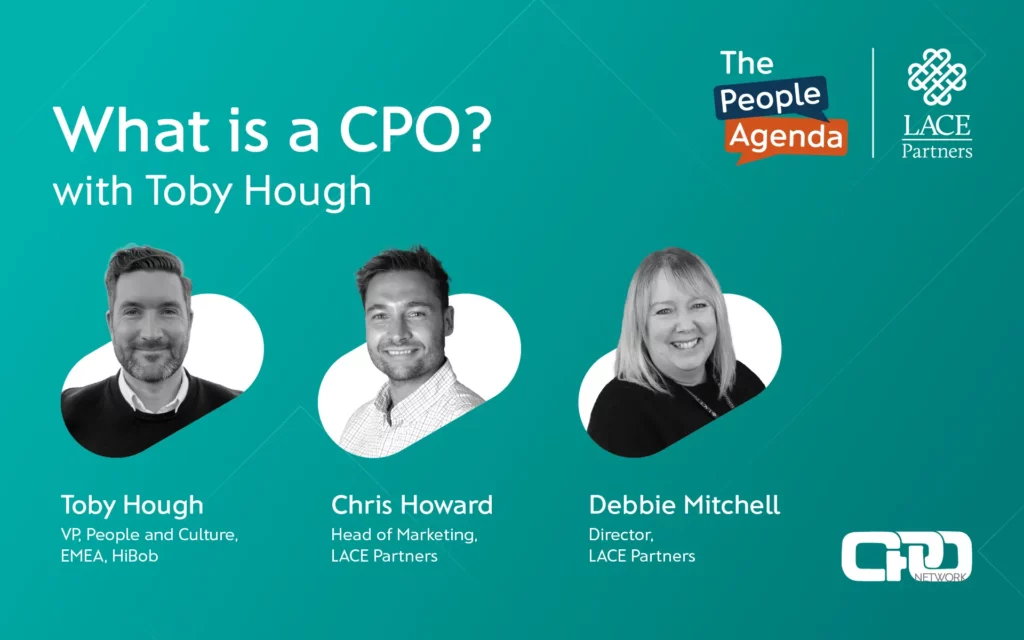
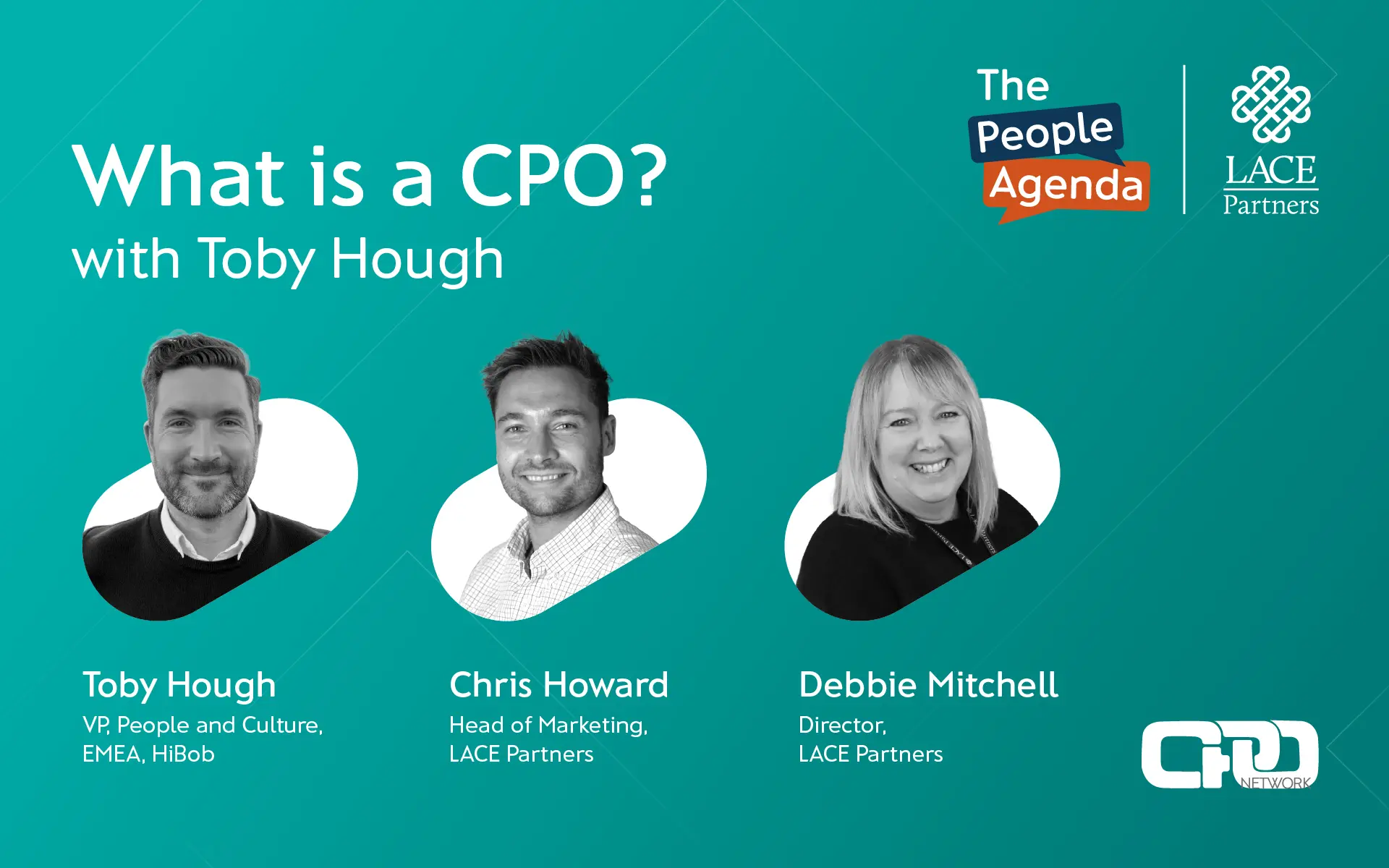
In this episode of The People Agenda, hosts Chris Howard and Debbie Mitchell from Lace Partners put that question to Toby Hough, VP of People and Culture for Europe at HiBob, for the latest instalment of the “What is a CPO” series.
Meet the guest: Toby Hough, HiBob
Toby has spent four and a half years at HiBob, an HR and finance platform, watching the business scale from small and medium customers to organisations of several thousand employees. His own team has grown from one person to nine, supporting 450 employees across five countries, while HiBob itself has gone from 100 to 1,400 people. That trajectory gives him a rare vantage point on HR leadership through hypergrowth and beyond.
What is a CPO’s real job description
Toby describes the CPO as “the spinal cord of an organisation.” He argues that post-COVID, and now in the AI era, businesses increasingly need a CPO who can challenge leaders across every discipline and translate between individual employee experience and board-level pressure.
|
“I would say it is the spinal cord of an organisation. Without a CPO at the heart of your C-suite, who is able to challenge leaders across all disciplines, slow down when things need to be slowed down in order to speed up in the right way, look round the corners and bring that translator role from the experience and impact of an individual employee up to the stresses and requirements that the CEO is under from the board or from investors, you can’t exist in that spinal cord place.” |
Scaling an HR team without losing focus
Diary discipline, a trusted team, and accepting that not every day will be equal: these are the three shifts Toby credits with freeing up space to think strategically. On people strategy specifically, he explains how his team’s plan went from 40 lines last year, which “was just overwhelming,” to 15 lines this year, forcing real prioritisation over doing everything at once.
Aligning HR strategy with business strategy
At 1,400 employees, HiBob has moved past the “low-hanging fruit stage” into an optimise phase, needing both continued growth and efficiency. HiBob deliberately delayed its own HR planning cycle so it could build around the business’s priorities first, an approach worth stealing for anyone trying to keep people strategy genuinely tied to commercial goals.
Culture, performance and the four hats of the CPO
Debbie introduces Lace’s four hats framework, covering compliance, transformation, experience and the CPO as organisational conscience. Toby responds with a sharp point on culture: “we should never talk about preserving culture… it’s really about intentional evolution.” He warns that culture is the first thing employees throw back at leadership after a badly handled difficult conversation.
AI adoption in HR: HiBob’s democratised approach
The episode closes on AI adoption in HR, and it’s the most quotable section. Toby describes cross-functional AI days where staff at every level build digital twins side by side: “I stopped and looked at this and thought, this is magical.” HiBob’s guiding principle: “the access to tools needs to be simple and democratised.” Toby, initially sceptical of his own digital twin, now uses it daily for email drafting: “I quite like him.”
In brief
- Toby Hough, VP of People and Culture Europe at HiBob, unpacks what a CPO role actually involves as a business scales from 100 to 1,400 employees
- Covers people strategy, prioritisation and aligning HR planning with business strategy
- Closes with a candid look at HiBob’s approach to AI adoption in HR, including digital twins and company-wide enablement days
Listen to the full episode of The People Agenda to hear Toby’s take on the four hats of the CPO and what it means for an HR team to be “customer zero” for its own product.