
AI is one of the most disruptive forces impacting businesses today and it’s already changing the day-to-day reality of transformation delivery.
At LACE, we are constantly exploring and leading the discussion around AI’s impact across HR and transformation.
In our first blog in our ‘Bringing AI to change without making change less human’ series, we covered level one ‘The starting point’ with practical advice on how to start using AI for transformation tasks. In our second blog, level two ‘AI supports transformation thinking’, we showed how AI can support your thinking, alongside the opportunities and risks that come with this level of AI literacy.
In this blog, we explore Level three ‘AI as a change agent’, where AI helps you deliver change at scale in fundamentally different ways. We also set out a practical set of design principles to consider before using AI as a direct interface with employees or as an ‘always on’ change agent.
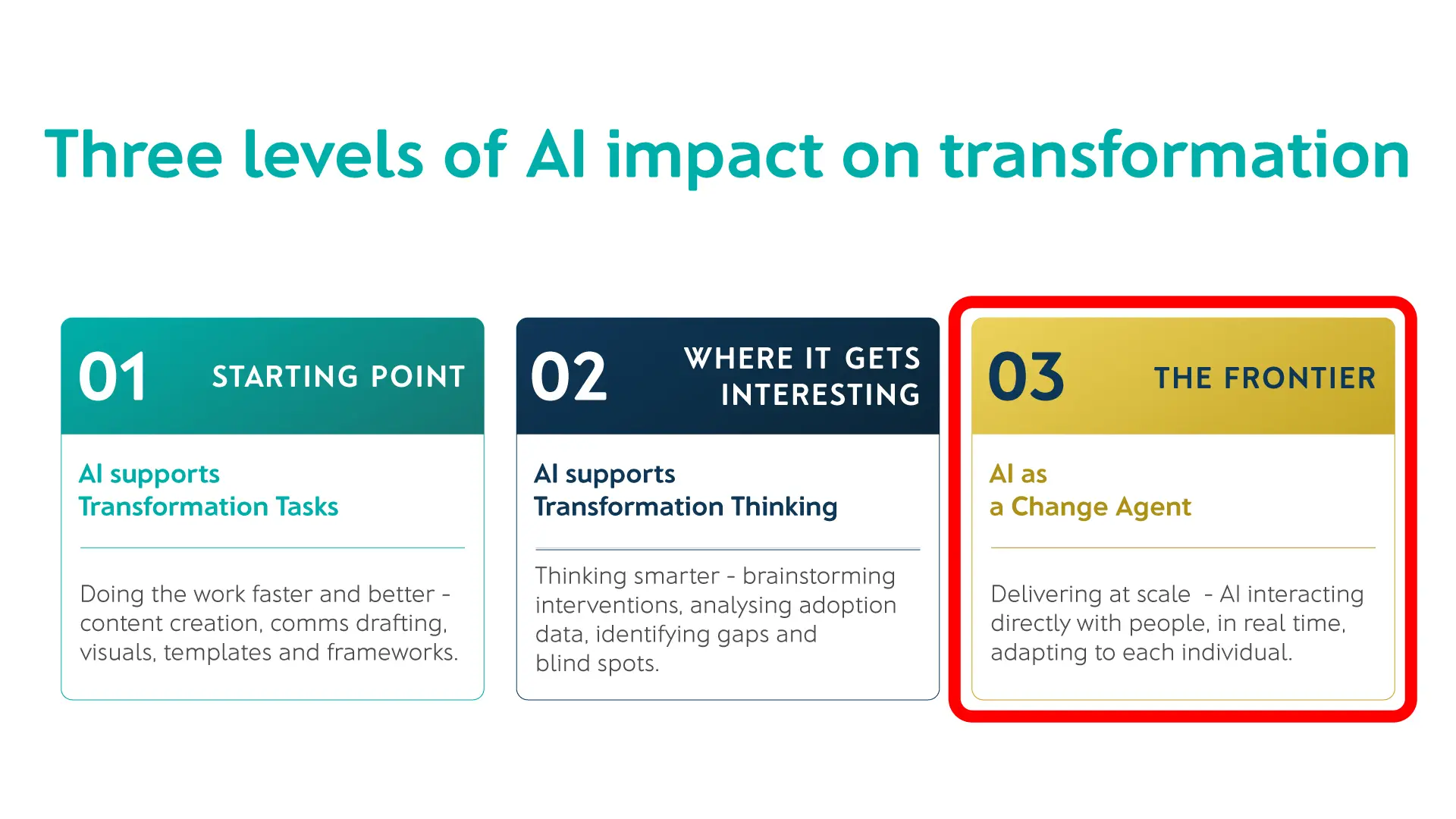
The frontier – Level three: AI as a change agent
What Level three really means
Level three is the point where AI is no longer just part of the change team’s toolbox but also starts to become a change enabler in its own right.
It can be the interface that employees will interact with directly: asking questions, receiving nudges, getting personalised support, and being guided through new ways of working in real time and often in the flow of work.
It can be your ‘always on change agent’: continuously monitoring sentiment, readiness and adoption dashboards, evolving solution architecture (organisational as well as digital), UAT and SRT issues logs, change impact and training needs, while providing live status updates; outlining risks and suggesting mitigations – or even acting on them itself.
This level is the frontier because it changes the shape of how change is delivered both inside the programme and towards the employees.
It introduces scale and responsiveness to drive change and adoption in transformation programmes that traditional approaches and legacy technology haven’t had the capability or capacity to deliver.
If the processes and interactions are thoughtfully designed, it can accelerate change, increase confidence, reduce frustration and create a more human experience at scale.
However, the minute AI makes decisions on your behalf or drives the interaction with your employees it needs to be held to the same high standards that you would ask of yourself as the change lead, as well as a key stakeholder, a leader or a change champion equipped to support and drive the change.
If you do not, your solutions risk drawing the wrong conclusions, coming across as generic and undermining trust in the programme, and potentially in the leadership driving it.
The core question at Level three isn’t “can we build it?” It’s “should we build it?” And if the answer is yes, the next question is: “where would AI genuinely improve the experience?”
Where this comes to life (use cases)
When you start to explore this level of AI enablement, it is easy to get excited by the art of the possible. Below are examples of solutions we are currently discussing with our clients:
1. Always-on change Q&A
An AI agent can answer questions 24/7, but the real value is not volume; it is relevance and reassurance. Use it to provide answers tailored to roles (frontline vs manager vs HR), offer “what this means for me” context (not just project facts), and signpost the right support route when a query suggests anxiety, risk or escalation needs.
2. In-the-flow guidance
People don’t forget training content because they’re lazy; they forget because they are typically taught in a vacuum. An AI agent can provide step-by-step help at the point of need, translate process language into plain straightforward language, and reduce dependency on stretched champions and SMEs for basic queries. Done well, this reduces frustration, which is often the hidden driver of resistance.
3. Personalised adoption nudges
An AI agent can send timely, relevant prompts to help employees build new habits, complete key actions, revisit training or use a new process when it matters most. The value is not in sending more reminders, but in making the nudge specific to the role, moment and behaviour you are trying to shift. Done well, this helps people move from awareness to action without adding more noise into already crowded channels.
4. Live change readiness radar
Readiness is often assessed in snapshots, but change rarely moves in neat reporting cycles. An AI agent can continuously track readiness indicators across stakeholder feedback, training completion, adoption data, issue logs and leader updates to flag where attention is needed. This gives change teams a clearer view of where confidence is building, where confusion is emerging and where support needs to be targeted before risks escalate.
5. Real-time sentiment monitoring
If you only gather sentiment every other week, you will miss immediate feedback, easy wins and early warning signs before minor challenges become bigger issues. With clear consent and governance, AI can help monitor themes across feedback channels, flag spikes in confusion or frustration and help change teams prioritise response activity where it matters.
6. Proactive risk and resistance management
Resistance rarely appears as one big moment. It often shows up first as repeated questions, low participation, workarounds, negative sentiment or small signs of disengagement. An AI agent can identify emerging adoption risks, resistance patterns or confusion hotspots, then suggest targeted interventions before issues become embedded. The human judgement still matters, but AI can help the team see the signals earlier and respond more precisely.
Design principles
When the decision has been made to design and deploy AI solutions as the direct interface with your employees or as an ‘always on’ change agent – the discussion around design principles becomes crucial – and it’s not a technical discussion but a human one. For example:
- What will the agent never do or suggest?
- What decisions must always stay with a human?
- How will we avoid overwhelming employees with prompts, nudges or messages?
- What happens when the agent is unsure about an answer, action or activity?
- How will we test and improve the solutions based on employee and programme feedback?
- What evidence will we use to decide whether the agent is improving adoption and employee experience?
- Who is responsible for keeping the AI agents up to date?
- Who is responsible for the answers, decisions and actions taken by the AI agents?
The opportunities to enhance the change experience for employees and change teams are what make the frontier level exciting. But discussing these questions upfront is what keeps it grounded and reinforces the series theme: the more advanced the technology, the more intentional we need to be about the human experience.
Getting started
Make sure you read part 1 ‘The starting point – Level one’ and part 2 ‘AI supports transformation thinking – Level two’ in this three-blog series.
FAQ
What does level three of AI-led change actually mean?
Level three is when AI stops being a background tool for the change team and starts acting as a direct interface with employees, answering questions, sending nudges and guiding people through new ways of working in real time.
What is an AI change agent in HR transformation?
An AI change agent is a system that interacts with employees directly during a transformation, handling things like Q&A, adoption nudges and sentiment monitoring, rather than just supporting the human change team behind the scenes.
Can AI monitor change readiness in real time?
Yes. AI can track readiness indicators across feedback, training completion, adoption data and issue logs continuously, giving change teams a live view of where confidence is building and where support is needed, rather than relying on periodic snapshots.
What are the risks of letting AI interact with employees directly?
If it’s not designed carefully, AI can draw the wrong conclusions, sound generic and undermine trust in the programme and its leadership. It needs to be held to the same standard as a human change lead.
What design principles matter most before deploying an AI change agent?
Key questions include what the agent should never do or suggest, which decisions must always stay with a human, how to avoid overwhelming employees, and who is accountable for the answers and actions the agent takes.
Want to talk about where you are on that journey? Want to understand how we are optimising our change tools and deliverables with AI for team use? Get in touch and tell us what’s on your mind.