
Many organisations have an embedded people analytics function. There is a plethora of organisations that we speak to at LACE who have some fantastic teams that deliver added value. While for some organisations people analytics is still a reasonably new concept, there is a vast range of scope, impact, and capability across businesses. So, for today’s blog, Johanna Clarke de Dromantin from our team has shared some thoughts on why organisations should lean into building a world-class people analytics function. From a LACE perspective, we believe it delivers better HR performance, better employee experience insights, and business value. We have noticed some key traits for those deemed to be ‘best in class’.
Organisations will want to assess their people analytics capabilities to understand where areas of improvement and opportunities are so they can make targeted investments that will drive tangible outcomes.
The traditional model for assessing people analytics is built on three layers of increasing maturity:
- Descriptive analytics – provides base data and insights that allow organisations to understand the current and past state.
- Predictive analytics – allows HR to plan for the future.
- Prescriptive analytics – the “golden nugget” of analytics, allows HR to understand ‘what will happen’ and ‘what to do about it’.
The traditional people analytics maturity model is one-dimensional and assumes that all HR functions need to progress step-by-step through descriptive, predictive and prescriptive analytics to become world-leading across every aspect of people analytics. However, it does not consider the varying needs of organisations, whether they are in a tight cost environment, a high growth or critical talent context. At LACE, we believe that people analytics capability should not be judged solely on their ability to generate advanced predictive and prescriptive data, but instead, it should be a holistic assessment of all factors that drive business value. We find clients can deliver substantial value with a blend of different analytics approaches; even if their data is imperfect or they don’t have access to the latest technology or advanced modelling techniques.
The LACE methodology to assess the capabilities of an organisation’s people analytics rests on five pillars that are essential for a high-performing function (strategy, systems and data, reporting and analytics, operating model and skills and behaviours). These pillars – which we have structured into questions below – also allow organisations to benchmark themselves against other organisations as well as assess their progress in developing their people analytics function.
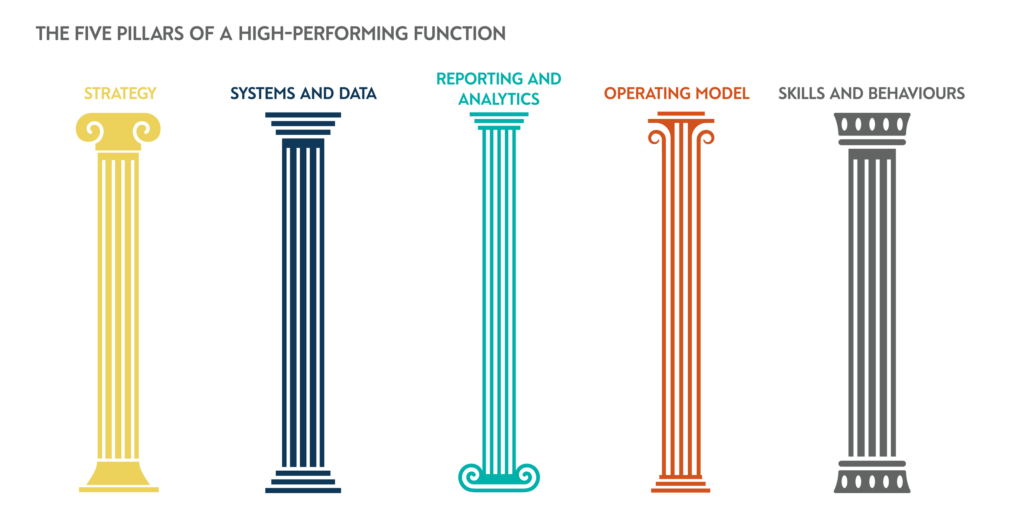
Is your people analytics strategy embedded?
The goal is to understand how well the people analytics strategy is embedded into and aligned with the organisation’s overall goals.
How effective are your systems and data?
What we are trying to understand in this section is the effectiveness of data management and how well-structured the HR data foundation is. Essentially, we are asking, do the right people have easy access to accurate data that they need to perform their roles?
Are your reporting and analytics mechanisms answering the fundamental business questions?
The focus of this section is on the application of analytics to answer business questions. Looking at how the metrics affect business outcomes and support HR initiatives. This is also where we assess if the right level and application of analytics is being used.
Is your people analytics operating model fit for purpose?
This is about the structure and governance of the people analytics function. Is there clarity of roles and responsibilities, as well as the level of leadership support and collaboration across other functions in the business? This helps to understand how well the people analytics function is integrated and supported into the broader organisation.
Do you have the right skills and behaviours in your team?
People analytics should be considered in the context of the wider HR and business context. We consider the levels of data literacy within the wider HR team and organisation to identify development needs. It also assesses if analytics outputs are delivered in a way that the stakeholders can take meaningful insights from.
This comprehensive overview of your people analytics strengths and development areas enables CPOs to support and advance the function more effectively. You don’t need to be leading in every pillar that is business context dependent. But understanding lets you build your roadmap. Thinking about ways to strategically improve the people analytics function is necessary as there is increasing pressure on HR teams, by leadership and external factors, to deliver high-quality analytics that help organisations gain a competitive advantage.
To support the LACE methodology and showcase how important it is to have an initial understanding of where your people analytics function sits, we have developed a tool called the Navigator. We have named it the Navigator because we recognise that developing a high-performing people analytics function is not a linear journey; it varies based on each organisation’s unique needs, goals, and capabilities.
We have made available a simplified version of the Navigator which is a free, online tool that is available to use. It is a simple online survey that takes less than 10 minutes to complete. Ideally, to gain a holistic understanding of your organisation, we would encourage multiple people in an organisation to answer the survey.
It is a great start to begin discussions and gain initial insights into where your organisation sits against all the pillars, and how you compare to other organisations. By completing the Navigator, we will provide you with a customised report outlining your strengths and areas that you may wish to focus on. It represents the first step of a longer process, but it will already help you navigate to where you want to go.
Access the Navigator here
If you’d like to talk to us about your People Analytics function then you can reach out to us using the form below.